AI-powered search is changing how businesses are discovered online. As more people rely on AI-generated answers instead of traditional search results, business owners are beginning to ask a new question: Why do some companies appear while others don't? To better understand the answer, I completed AI Visibility Audits across three very different industries: healthcare, banking, and enterprise SaaS. I expected to find three different optimization strategies. Instead, I found one repeatable framework that revealed surprisingly consistent AI discovery patterns.
Key Takeaways
-
Why healthcare, banking, and SaaS revealed similar AI visibility patterns
-
What AI-powered search consistently rewards across industries
-
Why strong expertise doesn't always translate into AI search visibility
-
How AI Overviews evaluate content beyond traditional rankings
-
What business owners can do to improve their visibility in AI-powered search
Expecting each industry to require a completely different approach felt like a sensible assumption. Healthcare content must communicate complex medical information responsibly. Banking content is built around trust, regulations, and financial decision-making. Enterprise SaaS companies have the challenge of explaining technical products in ways prospective customers can quickly understand. They solve very different problems, so it seemed reasonable to expect three different evaluation methods.
That wasn't what happened.
Although the terminology, audiences, and products changed, the same opportunities surfaced again and again. By the end of the third audit, it became clear that improving visibility in AI-powered search is often less about industry expertise and more about how clearly information is organized, connected, and presented.
Why I Compared Three Different Industries
Healthcare, banking, and enterprise SaaS represent three distinctly different content environments.
If discoverability in AI search depended primarily on industry, each audit should have required an entirely different framework. Instead, the same structured process consistently identified similar opportunities. While the subject matter changed, the questions remained remarkably consistent.
-
Can AI quickly identify the primary answer?
-
Is the information organized into logical sections?
-
Are related entities and concepts clearly connected?
-
Does the content answer the questions users are actually asking?
-
Can AI easily interpret and retrieve the information?
Those questions applied regardless of the industry being evaluated.
Pattern #1: AI Rewards Clear Information Before Industry Expertise
Every organization I evaluated demonstrated deep expertise within its field, but that wasn't the issue. The opportunity was making that expertise easier to understand.
Experiences like Google AI Overviews are designed to retrieve information quickly. Pages that present clear answers, logical organization, and well-defined relationships between ideas are simply easier to interpret.
Across all three industries, many recommendations focused on the same principles:
-
Clear answer-first sections
-
Strong information hierarchy
-
Explicit relationships between concepts
-
Better organization around user questions
None of these recommendations required changing the expertise itself. They focused on improving how that expertise was communicated.
Pattern #2: Strong Content Doesn't Automatically Create AI Search Visibility
One of the biggest misconceptions about AI-powered search is that authoritative content will naturally earn visibility. Yes, authority certainly matters, but authority alone doesn't guarantee discoverability.
Each audit included content that was informative, well-written, and supported by subject matter expertise. Yet every evaluation revealed opportunities to improve how information was presented.
In one audit, important answers were buried deep within longer sections instead of being introduced clearly near the beginning of the page. In another, closely related concepts weren't connected as explicitly as they could have been. The topics were completely different, but the retrieval challenges were surprisingly similar.
In short, the information wasn't the problem. The opportunity was making that information easier to discover, interpret, and retrieve.
Pattern #3: AI Discovery Patterns Repeat Across Industries
By the third audit, the pattern had become difficult to ignore. Although the industries had little in common, many of the recurring visibility opportunities looked remarkably familiar.
Healthcare
Topic Focus: Medical Information
Common Opportunity: Improve answer extraction and organize information into clearer, answer-first sections.
Banking
Topic Focus: Financial Services
Common Opportunity: Strengthen information architecture and expand coverage around the questions customers actually ask.
Enterprise SaaS
Topic Focus: Software Solutions
Common Opportunity: Improve retrieval clarity by strengthening entity relationships and making technical concepts easier to interpret.
After completing three very different audits, the same evaluation patterns continued to surface. The graphic below summarizes the themes that appeared regardless of industry.
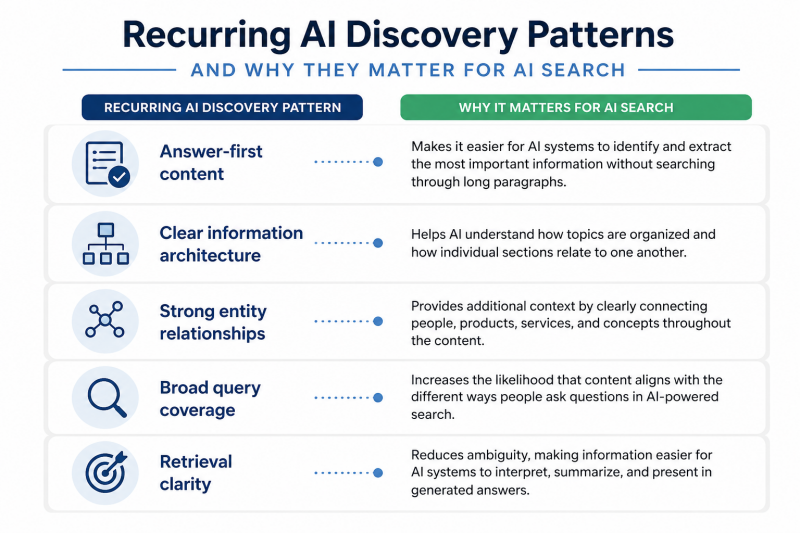
None of these patterns were unique to healthcare, banking, or SaaS. They were recurring characteristics of content that AI systems could understand, retrieve, and connect more effectively. That's what made the framework repeatable.
The cleanest takeaway is that these companies benefited from the same evaluation framework.Sure, they have different topics, audiences, and terminology, but the same themes appeared repeatedly:
-
Retrieval clarity
-
Information architecture
-
Answer-first organization
-
Stronger entity relationships
-
Broader query coverage