SEO content isn’t broken. But it is incomplete.
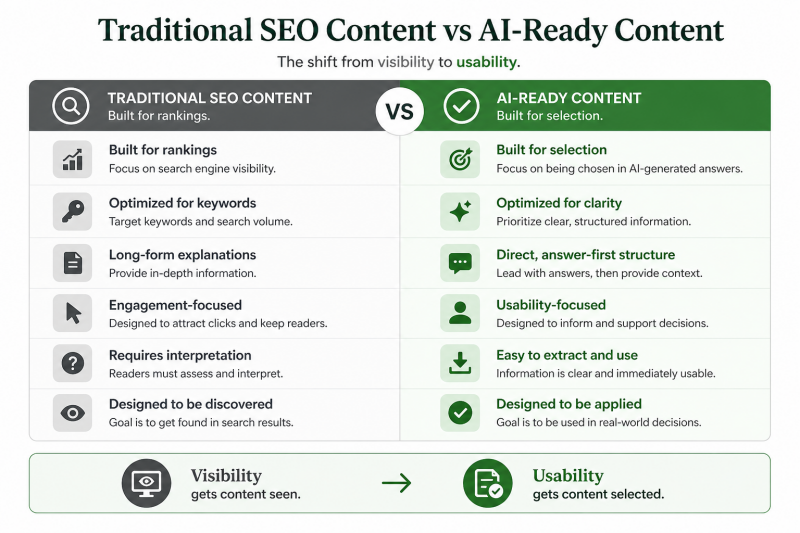
Traditional SEO was designed to help content get discovered. AI-driven systems are designed to determine what gets used. That distinction changes how content should be structured, evaluated, and written. Content that performs well in search does not automatically perform well in AI-generated answers, as selection now depends on important elements such as clarity, structure, and usability rather than visibility alone.
What Traditional SEO Content Was Built For
Traditional SEO content was designed to:
- rank for keywords
- attract clicks
- keep users on the page
This framework led to content that:
- prioritizes keyword coverage
- uses long-form explanations
- delays answers to build engagement
The goal was visibility.
What AI Content Is Built For
AI-ready content is designed to:
- answer specific questions
- provide clear, usable information
- support decision-making
This leads to content that:
- starts with direct answers
- uses clear structure
- provides complete context
The goal is usability.
Why SEO Content Often Fails in AI Systems
SEO content can still perform well in search results but still fail to appear in AI-generated answers. Why does this happen?
- Answers are not clearly stated
- Structure is inconsistent
- Context is incomplete
- Information requires interpretation
AI systems do not reward effort, but it does reward usability.
What AI-Ready Content Looks Like
AI-ready content follows a consistent pattern:
- answering a specific question immediately
- organizing information clearly
- defining key ideas explicitly
- providing enough context to act
This makes the content easy to extract, easy to combine, and easy to present.
What to Do About It
To adapt your content strategy, do the following:
• start with direct answers
• structure content clearly
• prioritize clarity over length
• provide complete, usable context
• reduce the need for interpretation
One key note to remember: this is not a replacement for SEO. It is an evolution of it.
Where Most Teams Fall Short
Most teams continue optimizing for visibility while ignoring usability which creates a gap where content ranks well but is not selected. Closing that gap requires rethinking how content is structured, and not just how it is optimized.
If You Want to Identify the Gap
The fastest way to understand where your content is falling short is to run a structured analysis known as the AI Gap Analysis.
Final Thought
SEO determines what gets seen. AI determines what gets used. And the teams that understand both will control visibility.
Frequently Asked Questions
Is SEO still relevant?
Yes. SEO helps content get discovered, but it does not guarantee selection.
What is AI-ready content?
AI-ready content is clear, structured, and usable enough to be selected in AI-generated answers.
Can SEO content be improved for AI?
Yes, it can. You need to Improve structure and clarity to make existing content more usable.
What is the biggest shift from traditional SEO to AI-driven content selection?
The shift from visibility to usability.